
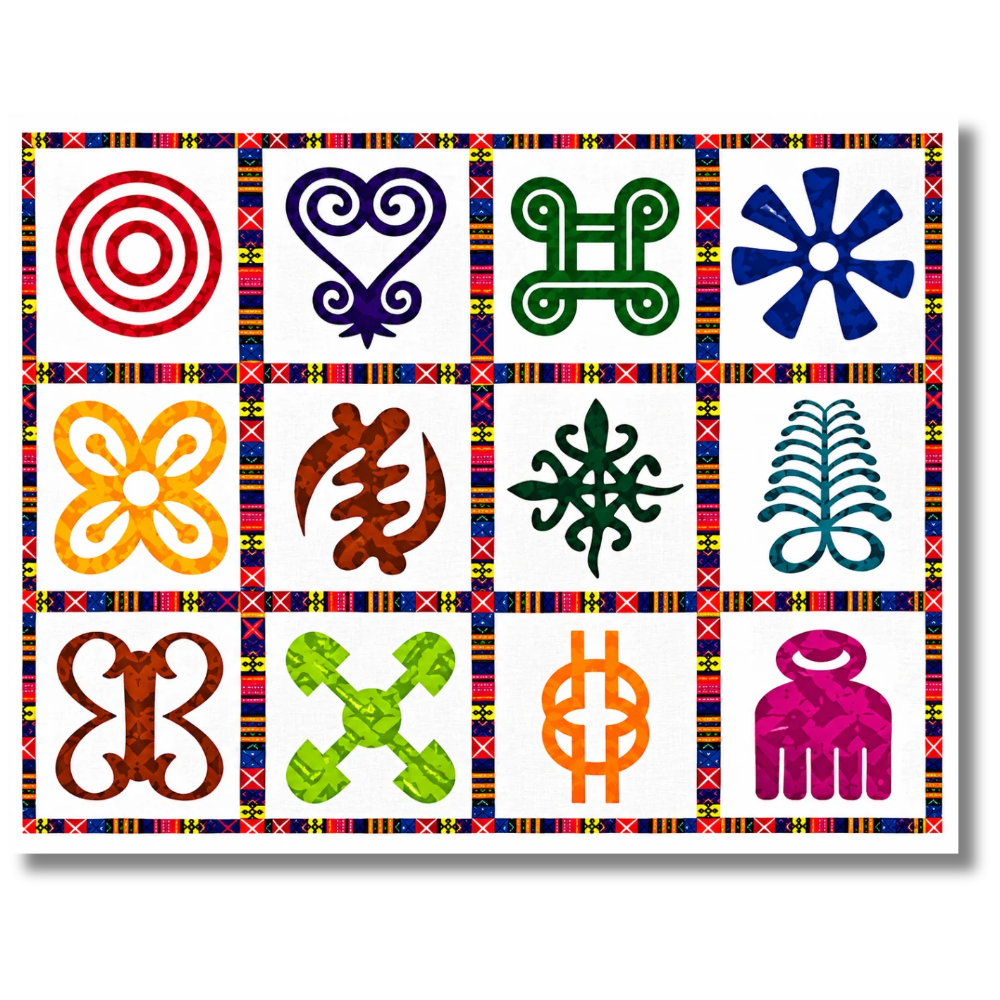
Adinkra Panel
Meet the 12 Adinkra Symbols in This Panel
Rooted in Ghanaian Akan philosophy, every Adinkra symbol is a visual proverb carrying a distinct lesson or virtue. Arranged from left to right, top to bottom, here is the meaning behind each motif featured in this design:
Top Row
- Adinkrahene (Red Concentric Circles) – "Chief of the Adinkra Symbols." Represents leadership, authority, and charisma, and is said to have inspired the creation of all other Adinkra designs.
- Sankofa (Purple Stylized Heart) – "Go back and fetch it." Teaches the wisdom of learning from the past and honoring your roots to build a stronger future.
- Mframadan (Green Geometric Cross) – "Wind-resistant house." Symbolizes fortitude, resilience, and preparedness to withstand life’s challenges.
- Ananse Ntontan (Blue Starburst Web) – "Spider’s web." Inspired by Ananse the spider of West African folklore, representing wisdom, creativity, and the complexities of life.
Middle Row
5. Bese Saka (Yellow Four-Part Motif) – "Sack of cola nuts." A symbol of affluence, abundance, power, and unity brought together through trade and community.
6. Gye Nyame (Rust-Brown Curved Motif) – "Except for God." The most iconic Adinkra symbol, expressing the supremacy, omnipotence, and eternal presence of God.
7. Funtunfunefu-Denkyemfunefu (Dark Green Crossed Crocodiles) – "Siamese crocodiles." Depicts two crocodiles sharing one stomach, symbolizing democracy, cooperation, and unity in diversity.
8. Aya (Teal Fern) – "Fern." Because the fern grows in difficult places, it represents endurance, independence, and resourcefulness.
Bottom Row
9. Dwennimmen (Brown Ram’s Horns) – "Ram’s horns." A reminder that true strength of mind, body, and spirit must always be paired with humility.
10. Akofena (Lime Green Crossed Swords) – "Sword of war." Modeled after ceremonial state swords, symbolizing courage, valor, and heroic achievement.
11. Wawa Aba (Orange Seed Motif) – "Seed of the wawa tree." Known for its extreme toughness, this seed represents hardiness, perseverance, and inner strength.
12. Mpuannum (Magenta Five-Tuft Motif) – "Five tufts of hair." Inspired by the traditional ceremonial hairstyle of Akan priestesses, symbolizing loyalty, devotion, and skillful service.
Choose options
Adinkra Panel
Sale price$33.99